Can Coding Agents Build Robust Baselines? A Skill-Based Approach for Automating the Medical Imaging Model-Development Pipeline
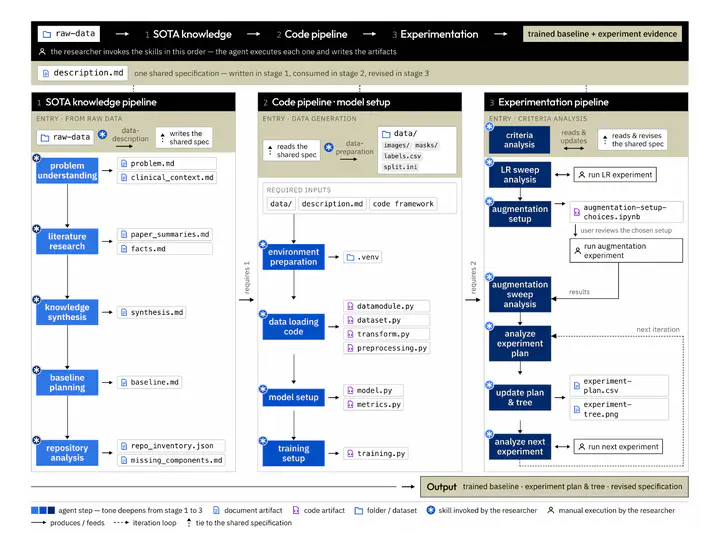 Figure 1. Overview of the proposed skill-based agentic framework. Raw inputs are converted into a structured task description and a standardized dataset. Three phases then synthesize task-specific knowledge, construct an executable modeling pipeline, and iteratively select, execute, and analyze experiments while maintaining a persistent experiment plan and tree. The task description persists across all phases and the researcher invokes each skill in order, reviewing and running the experiments the framework proposes.
Abstract
Developing competitive deep learning baselines for medical imaging remains a highly iterative process requiring literature review, implementation, experimentation, and expert refinement. Existing automation approaches typically optimize isolated components, such as architecture search or hyperparameter tuning, rather than the complete baseline development process. We present an agentic AI Scientist workflow that combines literature-guided reasoning, automated code generation, and hypothesis-driven experimentation to generate competitive baseline models for medical imaging challenges. The framework is evaluated on four public benchmarks spanning segmentation, classification, and detection. Across all tasks, the Experimentation Pipeline consistently improves validation performance, achieving competitive leaderboard results, including 6th place on both PUMA tracks (15 teams) and 31st place on MILK10k (125 teams). On MIDOG25, the resulting model also demonstrates strong domain generalization across scanners, tumor types, and species. Using the same workflow across all challenges without task-specific redesign, we demonstrate that skill-based, literature-guided agentic workflows can substantially reduce the engineering effort required to develop competitive medical imaging baselines.